
Odisha / Craft story 01
Talapatra painting
A story, one fine line at a time.
Palm leaf becomes a surface for memory, with each engraved line asking us to slow down and look.
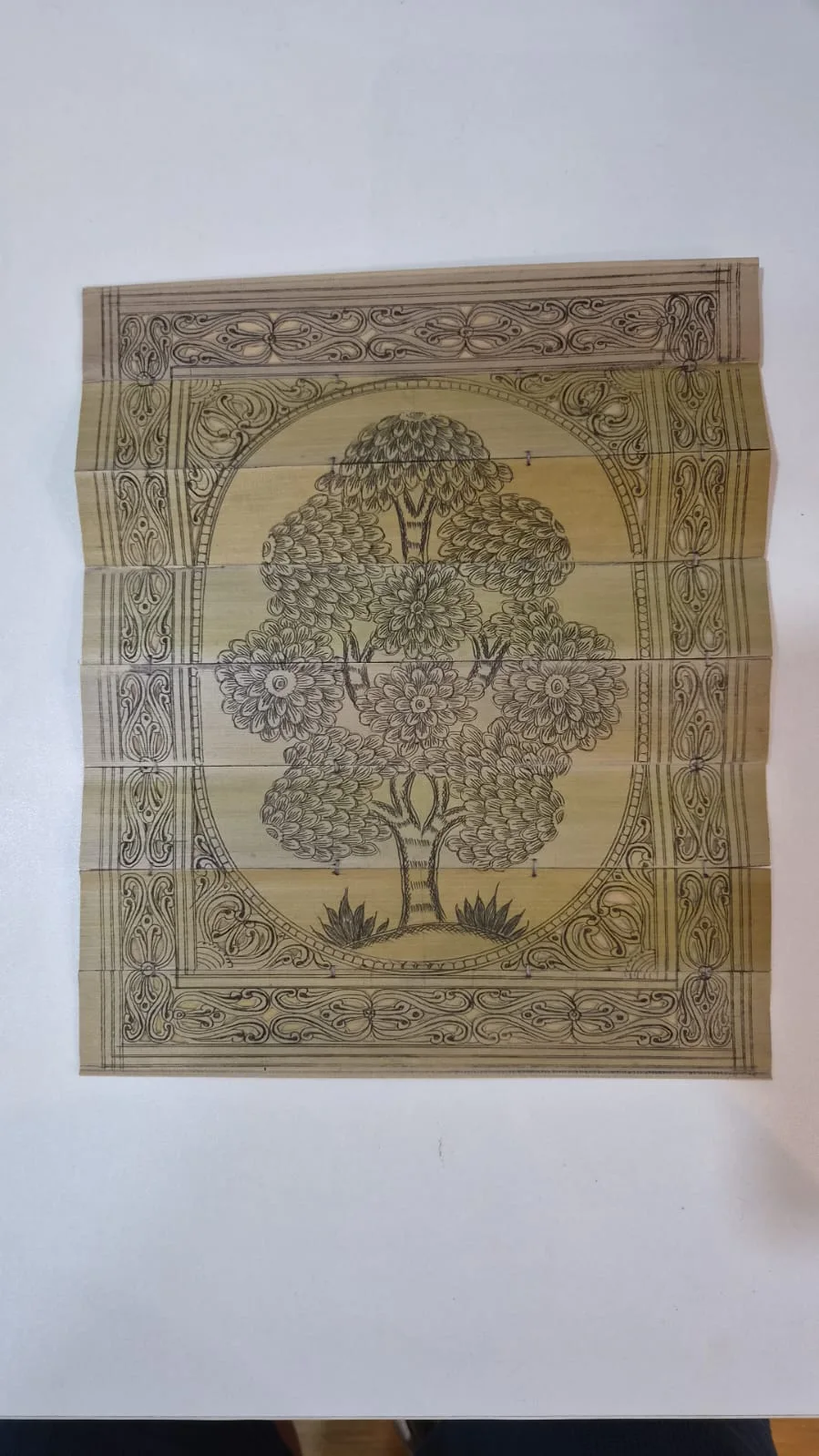
A leaf that holds a line
Talapatra painting is also known as Tala Pattachitra or palm-leaf engraving. Its distinction starts with the surface. Instead of painting a large field of colour on cloth, an artisan works fine incised lines into prepared leaves. Dark pigment rubbed into the cuts makes the drawing legible.
Gaatha's documentation connects this practice with India's history of writing and illustration on palm leaves. In Odisha, the leaf becomes both a record and an image: a place for narrative scenes, ornamental borders and intricate patterns. [1]
From individual strips to a composition
Leaves are prepared and joined to create a larger surface. The artist must consider the drawing and the divisions between strips together. An engraved line cannot simply be treated like a brushstroke on a continuous canvas.
- Prepare the surface. Palm-leaf strips form the ground for the image.
- Compose and incise. A pointed tool cuts the design into the leaf.
- Reveal the drawing. Dark pigment settles into the incisions, bringing fine detail into view.
The Crafts Council of Odisha describes palm-leaf engraving alongside Pattachitra while distinguishing the engraved leaf from painted fabric. [2]
Reading the details
In the photograph shared with GolGadi, a tree stands inside a decorated border. Look at the repeated leaf shapes, the small flowers and the way the drawing crosses the horizontal joins. This is an observation of the image, not an identification of its artist or a claim about the meaning of its symbols.
Some documented works use perforation or layered openings as part of the composition. Narrative subjects can draw on the Ramayana, Mahabharata and the Jagannath tradition. Not every work uses every technique or tells the same story. [1]
Place and living practice
Odisha Tourism identifies Raghurajpur near Puri as a centre for painting on cloth and engraving on dried palm leaves. Seeing the two together helps explain their shared visual setting without confusing their materials. [3]
When you meet a maker, ask how the leaves were prepared, how the panels are joined, and what the composition means to them. The answers can make a familiar-looking image unexpectedly personal.
A careful note on GI recognition
The official register lists Orissa Pattachitra under application 88. We do not make a separate GI claim for the Talapatra reference shown here, or assume a particular palm-leaf piece is covered without checking its provenance and the registration's scope. [4]
Sources & further reading
- Gaatha: Tala Pattachitra, Raghurajpur
- Crafts Council of Odisha: Pattachitra & Palm Leaf Engraving
- Odisha Tourism: Raghurajpur
- IP India: Orissa Pattachitra, application 88
This is a researched introduction to a craft tradition. It is not a maker profile, a product specification or a claim of GI certification for GolGadi.